

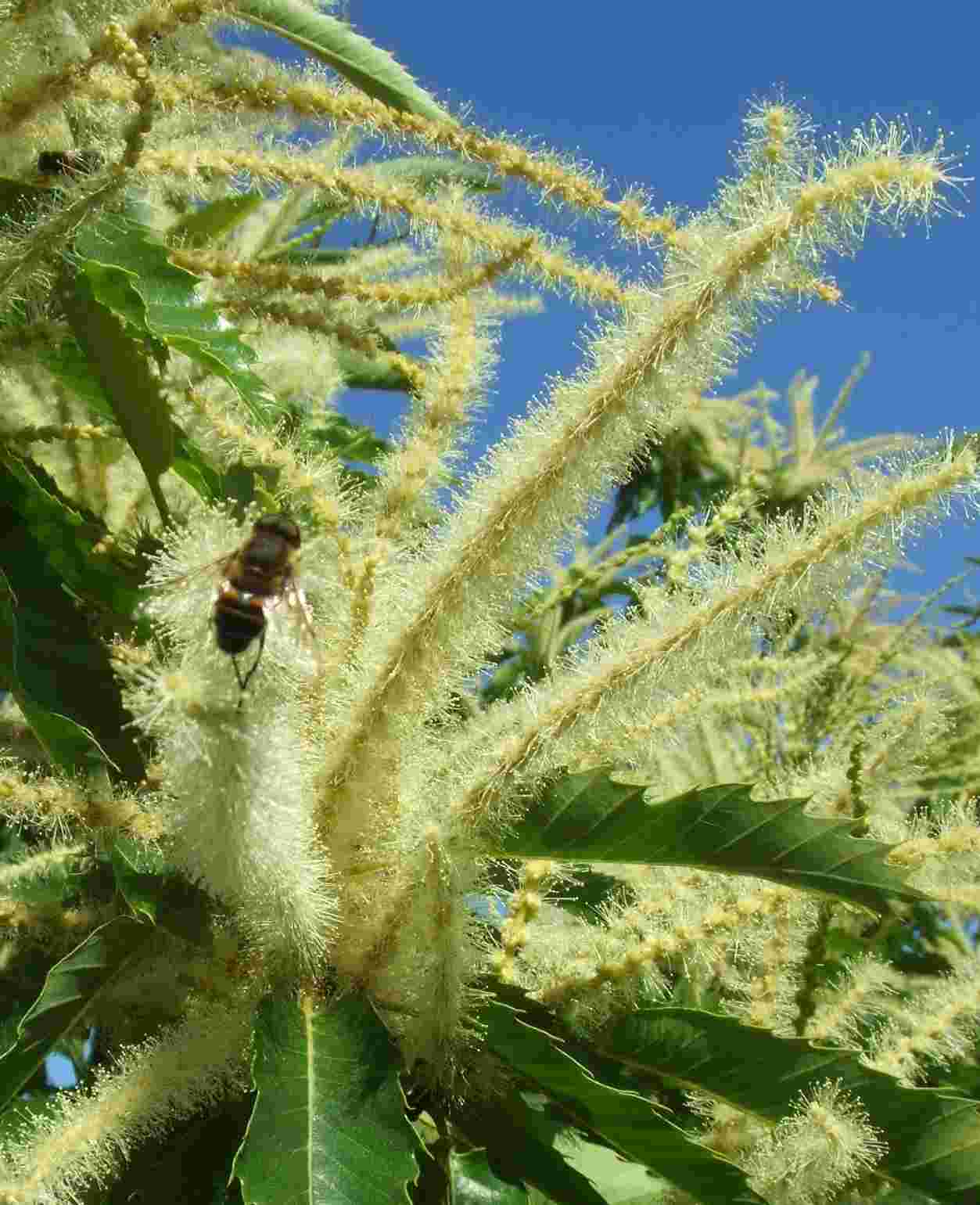
The chestnut tree belongs to the same family as beeches and oaks. For thousands of years the chestnut was a primary source of nutrition in the mountainous areas of the Mediterranean where grains did not grow well. The primary honey producer, the sweet chestnut tree (Castanea sativa) is common in Europe where it was introduced from Sardis (in what is now Turkey) thousands of years ago, hence the name Sardinian Nut, now known simply as the chestnut…not to be confused with Sardinian honey, so called because it is produced on the Italian island of Sardinia.
Although not a nectar-producer, the American Chestnut (Castanea dentata), a native species of the United States, once grew so densely it was said a squirrel could jump from tree to tree without once touching the ground between New York State and Georgia. In an ecological disaster, close to 4 billion trees in the Eastern United States were wiped out in the early 1900’s by a blight. Efforts to create a hybrid resistant to the blight are ongoing. Fortunately the Sweet Chestnut has shown resistance to the blight and as a happy consequence we are able to enjoy chestnut honey from these nectar-producing trees.
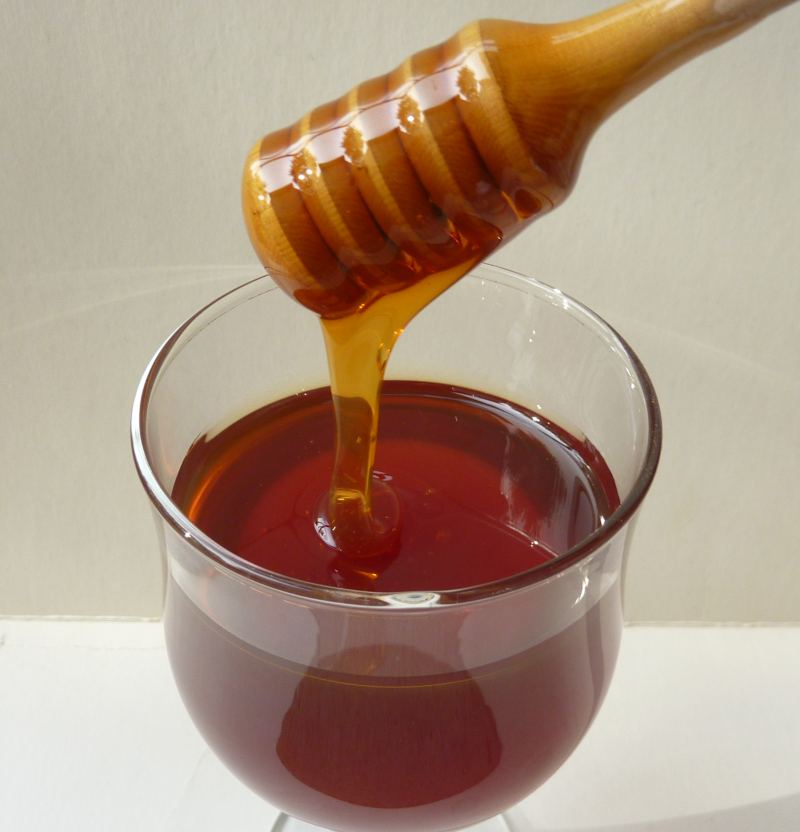
Chestnut honey has a strong aromatic taste and a slightly bitter after taste. Rich in pollen content, mineral salts and tannin, with a high proportion of fructose that resists crystallization and a relatively low acidity. Dark in color, ranging from yellowish brown to almost black, sometimes with amber hues, it has an aromatic, pungent herbal aroma and taste and slightly tannic (due to the tannin in the tree). The flavor is unique, not very sweet and with an almost bitter aftertaste and very persistent, highly appreciated by those who like a strong, less sweet honey. Blossoms from May to June.
It is excellent with aged cheeses (Stracchino, Ricotta) or hearty meat dishes. Or try it the Tuscan way; drizzled over a piece of Pecorino Toscano with some fresh pears.

Of the common species of Chestnut trees, the Sweet Chestnut (Castanea sativa) grown mainly in Europe produces honey, and the Allegheny Chinkapin (C. pumila) grown in Eastern USA produces a strong and bitter honey.
In Asia, the Japanese Chestnut (C. crenata) grown mainly in S. Korea is a source of honey. The Chinese Chestnut (C. mollissima), Henry Chinkapin (C. Henryi), Sequin (C. Seguiniii) are grown in China and may be sources of honey.
Two chestnuts are not members of the same family at all, the Horse Chestnut or Conkers (Aesculus hippocastanum) which grows around the temperate world and is not edible, and Water Chestnuts (Family Cyperaceae) an aquatic vegetable grown in China. Neither are related to Castanea chestnut trees.
Festivals: Italy has the most Chestnut festivals, but it is also celebrated in France, Greece, Switzerland and the USA.
In Italy, in early Autumn, many fairs and festivals can be found in Italy celebrating the chestnut, which was for centuries one of the main nutrients of the people. Enjoy the amenities of the country, be prepared to taste delicious chestnuts in soups, pastas, stuffings, stews and desserts, in dishes ranging from ravioli to ciacci (small, stuffed pancakes made from chestnut flour) to biscottini di Marroni (chestnut cookies). And for the gourmet; gnocchi, cotechino, sausages and other typical products, including regional wines. Perhaps music, dances and songs. And all the while, learning about the medieval villages, where you can visit beautiful regions and towns while sampling chestnuts and of course, fabulous Chestnut honey!
- Montalcino, Italy – Honey Week (Settimana del Miele), held in September
- Soriano nel Cimino, Italy – The Chestnut Festival (La Sagra della Castagne), held the first two weeks of October.
- Summonte (AV), Italy – The Chestnut Festival (Sagra della Castagne), held mid October
- Sassofortino (GR), Italy – The Chestnut Festival (La festa Della Castagna), Late October
- Trecchina, (PZ), Italy – Friends of the Chestnut (Amici della Castagna), held mid October
- Valle di Soffumbergo, Faedis (UD), Italy – Festival of Chestnuts and Chestnut Honey (Festa delle Castagne e del Miele di Castagno), held early October
- Bregaglia, Switzerland – Chestnut Festival (Festival della castagna, Kastanienfestival ), held late September, early October
- Monts d’Ardèche, France – Chestnut Festival (Castagnades d’Automne), a series of chestnut festivals in the Regional Natural Park of Monts d’Ardèche from early October to early November.
- Collobrières, France – Chestnut Festival – (Fêtes de la Châtaign), last three Sundays in October
- Pelou, France – Chestnut Fair (Foire de la châtaigne), held late October
- Elos in the Ennio Khoria (9 Villages) district near Kissamos, Crete, Greece – Chestnut Festival of Elos, 3rd Sunday of October
- Arna in the prefecture of Laconia, Greece – Chestnut Festival, last weekend of October
- Kastanitsa in the Prefecture of Arkadia, Peloponnisos, Greece – A chestnut festival in Kastanitsa
- Rowlesburg, West Virginia, USA – West Virginia Chestnut Festival, held in early October
Latin Name: Sweet or Spanish Chestnut (Castanea sativa), Allegheny Chinkapin (Castanea pumila), Japanese Chestnut (Castenea crenata)
[Chinese Chestnut (C. mollissimai), Henry Chinkapin (C. Henryii), Sequin (C. Seguinii) may be sources of honey but not confirmed]
Translations: Italian: Miele di castagno; Turkey: Kestane balı; France: Miel de châtaignier; Germany: Kastanienhonig; Spain: Miel de castaño; Greece: Το μέλι καστανιάς; Albania: Mjaltë gështenjë; Japanese Chestnut (Castenea crenata – 日本栗 – ri ben li); Chinese Chestnut (C. mollissima – 板栗 – li); Henry Chinkapin (C. Henryi – 锥栗 – zhui li); Sequin (C. Seguinii – 茅栗 – mao li)
Sources: Main: Albania, China, Turkey, Italy, Spain, Switzerland, France; Secondary: Austria, Belgium, Germany, Greece
Health Benefits: Rich in trace minerals and iron, vitamins B and C, Chestnut Honey strengthens muscles, blood circulation, regulating, liver and stomach, relieving fatigue, strengthens the immune system. Chestnut Honey brings positive effects to the respiratory and digestive systems.
| Protected Geographical Status (PGS) framework (PDO/PGI) – EU: |
 Italy – Lunigiana (Tuscany): Chestnut honey is harvested at the end of June and beginning of July (DOP – Italian version of PDO). Along with the DOP certification, it must indicate the town where it was produced: Aulla, Bagnone, Casola in Lunigiana, Comano, Filattiera, Fivizzano, Fosdinova, Licciana Nardi, Mulazzo, Podenzana, Pontremoli, Tresana, Villafranca in Lunigiana, or Zeri. |
  Spain – Miel de Galicia (NW Spain): Chestnut honey occurs primarily in the provinces of Lugo and Ourense (including the regions of A Fonsagrada, A Ulloa, Ancares, O Courel, The Sierras of Manzaneda, San Mamede and Invernadeiro, the valley of the Sil, O Bolo, and Valdeorras). The province of Pontevedra’s main production area is Deza and the Terra de Montes. |
 Spain – Miel de Granada (S Spain) Chestnut honey occurs in the Province of Granada. Beekeepers migrate their hives within the province as necessary to collect chestnut nectar. |
Photo Credit (chestnut blossoms): Iris Lisson


Leave a Reply