
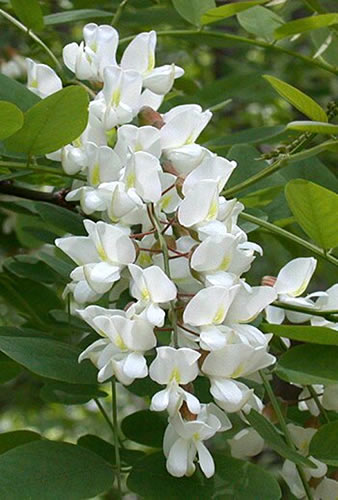
Commonly sold in Europe as Acacia honey and in the United States as Locust or American Acacia, this honey is obtained from the False Acacia or Black Locust tree (Robinia pseudoacacia) and seldom from Acacia species at all. Also, it shouldn’t be confused with the Honey Locust (Gleditsia triacanthos), which, in spite of its name, does not produce honey at all.
The honey is extremely light colored, lemonish white or yellow-green, and if relatively free of other floral sources, it can be very transparent, like liquid glass. The aroma is floral, fruity, delicate, very persistent. The flavor is very sweet, slightly acidic with hints of vanilla and no aftertaste. The flowery notes are noticed best in the finish.
It has a lower acid content. It’s delicious combined with cheeses, especially pecorino and gorgonzola cheese. Because of its light taste, it is good for children and ideal on fresh cheeses (ricotta), yogurt, fruit and ice cream. The honey remains liquid and does not crystallize easily due to its high fructose content.
The black locust tree or false acacia, is native to eastern North America and widely planted in Europe. In France, Italy and Hungary it is known as Acacia honey. The honey in the US is sometimes labeled “American Acacia” or “Locust Honey”. The tree grows from 30 to 70 feet and blossoms in May to June. During this time it can easily be found by following the highly aromatic, wonderfully sweet smell of the ample drooping clusters of white blossoms. Bees are drawn to the calyxes filled with nectar, returning throughout the day for ten days or so during the blossoming time. Nectar flow is dependent upon the weather and may not be consistent from year to year.
While different species, Acacia, Black Locust and Honey Locust all belong to the same family Fabaceae or Leguminosae (beans/ legumes). Also, in spite of its name, the Honey Locust tree (Gleditsia triacanthos) is not a honey producing plant. The name comes from the sweet tasting pulp of the pod-shaped fruit of the tree once used as food by American Indians.
Latin Name: Robinia pseudoacacia L.
Translations: Italian: Miele di robinia o acacia; French: Miel de robinier – Acacia, robinier faux acacia; Hungarian: Akácméz; German: Akazienhonig – Robinie-Honig
Honey Origin: Eastern North America and Europe. The main producers are Bulgaria, Hungary and Romania but it is also found in Canada, China, France and Italy.
Protected Geographical Status (PGS) framework (PDO/PGI) – EU:  In the second half of May, Acacia honey is collected in the Lunigiana (Tuscany) Region of Italy (DOP – Italian version of PDO) Along with the DOP certification, it must be indicate the town where it was produced: Aulla, Bagnone, Casola in Lunigiana, Comano, Filattiera, Fivizzano, Fosdinova, Licciana Nardi, Mulazzo, Podenzana, Pontremoli, Tresana, Villafranca in Lunigiana, or Zeri
Image from: www.dnr.mo.gov


Leave a Reply