

Weather in Wheaton, IL USA
To improve the video quality, move your cursor over the video to reveal the image quality menu. Set Quality to 75% for best image. If you have a low bandwidth connection, set Fps to 10 or 15. The video will display for 20 minutes before you need to reload the page. If the image is black, it is most likely night.
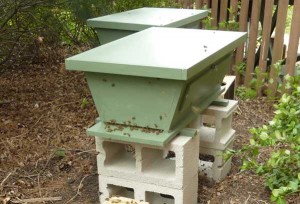
New Top Bar Hives. Click to view bee cam
Top-bar hives (started April 13, 2012)
What honey lover doesn’t dream about honey fresh from the hive? What better way than your own hives? Inspired by my beekeeping friend, Dan Fitzpatrick I built the two top bar hives with blue prints purchased from BackYardHive.com. The hives were completed April 13—Just in time—The two packages of bees that Dan ordered for me in Dec, 2011 arrived two days before! I am transfixed by these industrious creatures. So much so, I thought others might be too.

Looking Up -5-2-2012
Here are two images taken May 2, 2012 of the inside of the hive shown in the Bee Cam. Taken from the window on the side, the bright spot to the left is the entrance. You can just make out three combs, but there might be a fourth to the far left. The image to the right, “Looking Up” shows empty bars on the top (top bar hive) continuing to the right (click image for closeup). These bars stretch, like close-set railroad tracks, the entire length of the hive. Each will hold a comb. Some for honey and some for the young brood. The bees are making brood combs now. It looks chaotic, with bees everywhere, but the resulting cream-colored comb peeking through is crystalline in its regularity. They are each attached to a top bar, growing in size as they are built back from the entrance.

Looking down: 5-2-2012
They will all eventually fill the space below and beside, leaving only enough space for the bees to scurry by. The queen will busily fill these with eggs and new worker bees will emerge about 16 days later. At some point, they will begin making combs for honey. I’m not sure when this begins. Click on images to see close up. (Back to top)

Cam Hive 1 5-5-2012

2nd Hive 5-5-2012
Looks as if the are about to swarm
They’ve been clustering like this for weeks now. I’ve thought so too.
what do you feed the bees after you harvest their honey,Scott?
Hi Maria:
Haha! From some people that would be a loaded question Maria! I actually don’t harvest much honey from the hive. Out of about 8 honey combs total, I only take out one comb at a time, then replace the bar and wait for it to be refilled. Most beekeepers try to leave enough honey in the hive for the bees to last the winter. This is the primary use of the honey stores. If the winter is long and very cold, then they may feed the bees sugar water as a stopgap. Invert sugar is recommended. Some actually use honey.
…Scott
Greetings!
I fell in love with bees very recently and I live in wheaton too. I’m going to be taking a class on beginning beekeeping that starts in a few weeks. I’d like to get all set up an be able to get my first bees this spring. I’m looking for other people keeping bees in the area, in hopes that some may be willing to share their knowledge. I know it’s cold and there isn’t much activity at the hive this time of year, and I know that keeping bees can be a private thing. But.. If you are at all open to visitors to your hives, please let me know.
Good luck and may your bees be healthy and your combs bursting with honey this year!
Annelise
Hi Annelis:
Thanks! You are invited any time. I will send you my contact info by email.
…Scott
Hi Annelise:
I tried to send an email, but it got bounced. Please try my email address. [email protected]
…Scott